

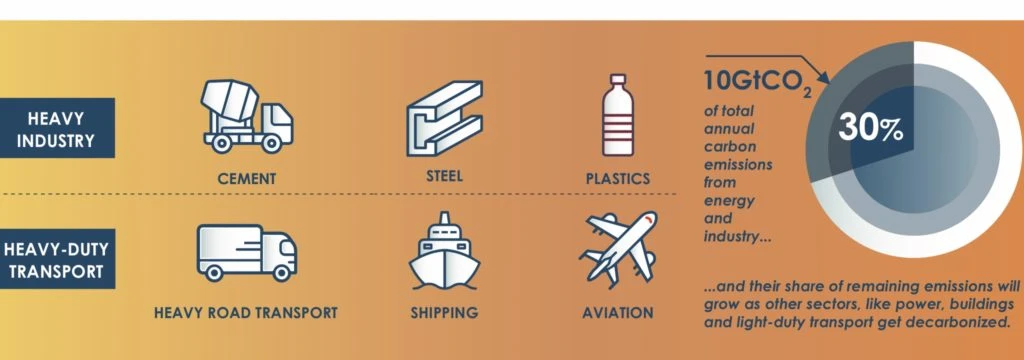
Reaching net-zero carbon emissions from heavy industry and heavy-duty transport sectors is technically and financially possible by 2060 – earlier in developed economies – and could cost less than 0.5% of global GDP, according to the Energy Transitions Commission (ETC). The report, Mission Possible: Reaching Net-zero Carbon Emissions from Harder-to-abate Sectors by Mid-century, outlines the possible routes to fully decarbonize cement, steel, plastics, trucking, shipping and aviation. These sectors together represent 30% of energy emissions today and could increase to 60% by mid-century as other sectors lower their emissions.

The Mission Possible report was developed with contributions from over 200 industry experts over a 6-month consultation process. Its findings show that full decarbonization is technically feasible with technologies that already exist, although several still need to reach commercial readiness. The total cost to the global economy would be less than 0.5% of GDP by mid-century, and could be reduced even further by improving energy efficiency, by making better use of carbon-intensive materials (through greater materials efficiency and recycling) and by limiting demand for carbon-intensive transport (through greater logistics efficiency and modal shift).
The report also shows that this would have only a minor impact on the cost of end consumer products. For example:
-
Green steel use would add approximately $180 to the price of a car.
-
Green shipping would add less than 1% to the price of an imported pair of jeans.
-
Low-carbon plastics would add one cent to the price of a bottle of soda.
In heavy-duty transport, electric trucks and buses (either battery or hydrogen fuel cells) are likely to become cost-competitive by 2030, while, in shipping and aviation, liquid fuels are likely to remain the preferred option for long distances but can be made zero carbon by using bio or synthetic fuels. Improved energy efficiency, greater logistics efficiency and some level of modal shift for both freight and passenger transport could reduce the size of the transition challenge.
Given the increasing problems with air pollution throughout India, the decarbonization of heavy industry and heavy-duty transport is crucial, not only to reduce the carbon in the atmosphere, but to improve the quality of life and health of citizens. The Indian industry is growing and has the opportunity to build new industrial capacity with state-of-the-art technology.
In industry, more efficient use of materials and greatly increased recycling and reuse within a more circular economy could reduce primary production and emissions by as much as 40% globally – and more in developed economies – with the greatest opportunities in plastics and metals. Reaching full decarbonization will require a portfolio of decarbonization technologies, and the optimal route to net-zero carbon will vary across location depending on local resources.
Across all sectors of the economy:
-
Direct and indirect electrification (through hydrogen) will likely play a significant role in most sectors of industry and transport, leading to a sharp increase in power demand – growing 4 to 6 times from today’s 20,000 TWh to reach around 100,000 TWh by mid-century).
-
Hydrogen use will almost certainly increase dramatically (7 to 11 times by mid-century), with two routes to zero-carbon hydrogen: electrolysis, which will likely dominate in the long term, and steam methane reforming plus carbon capture and storage.
-
Bioenergy and bio-feedstock will be required in several sectors, but will need to be tightly regulated to avoid adverse environmental impact (such as deforestation), and its use should be focused on priority sectors where alternatives are least available or more costly, such as aviation and plastics feedstocks.
-
Carbon capture (combined with use or storage) will likely be required to capture process emissions from cement and may also be the most cost-competitive decarbonization option for other sectors in several geographies. However, it does not need to play a major role in power generation, with the storage needs required could be less than many scenarios suggest. Tight regulation of storage is essential to ensure safety and permanence.
The report concludes that the most challenging sectors to decarbonize are plastics (due to end-of-life emissions), cement (due to process emissions), and shipping (because of the high cost of decarbonization and the fragmented structure of the industry).
Key policy levers needed to accelerate the decarbonization of harder-to-abate sectors include:
-
Tightening carbon-intensity mandates on industrial processes, heavy-duty transport and the carbon content of consumer products.
-
Introducing adequate carbon pricing, strongly pursuing the ideal objective of internationally agreed and comprehensive pricing systems, but recognizing the potential also to use prices which are differentiated by sector, applied to downstream consumer products and defined in advance.
-
Encouraging the shift from a linear to a circular economy through appropriate regulation on materials efficiency and recycling.
-
Investing in the green industry, through R&D support, deployment support, and the use of public procurement to create initial demand for “green” products and services.
-
Accelerating public-private collaboration to build necessary energy and transport infrastructure.
Industries and investors can anticipate the profound transformation in industry and transport they will eventually face by innovating and investing in decarbonization technologies and low-carbon infrastructure. The ETC provides the fact base for industry groups and private companies to develop roadmaps, collaborations and projects aiming for net-zero carbon emissions in their sectors. It also encourages businesses across multiple sectors to question their procurement practices and make commitments to buying “green” products and services.
The members of the Energy Transitions Commission are committed to achieving a net-zero carbon economy by mid-century. They are convinced that succeeding in that historic endeavor would not only limit the harmful impact of climate change, but would also drive prosperity and deliver important local environmental benefits.
Adair Turner, co-chair of the ETC said, “This report sets out an optimistic but completely realistic message – we can build a zero-carbon economy with a minor cost to economic growth. We should now commit to achieving this by 2060 at the latest, and put in place the policies and investments required to deliver it.”
Credit: Source link












Leave a Reply